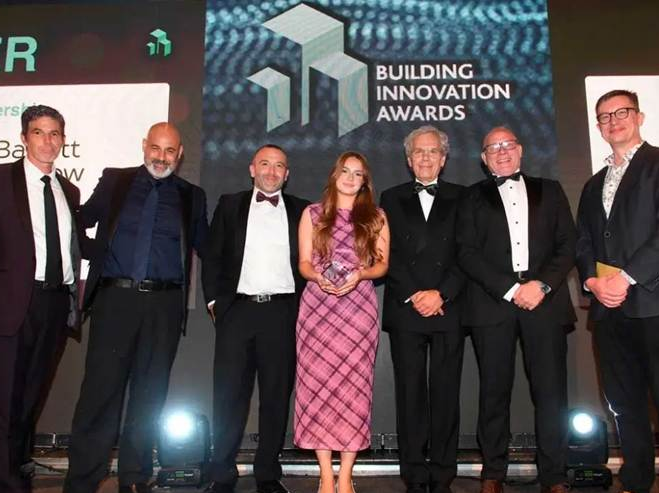

A unique partnership between housebuilders, manufacturers and academics has won a national award for its research into low carbon homes. The Future Homes Project @ Energy House 2.0 brought together The University of Salford, Bellway, Barratt Redrow and Saint Gobain. The landmark collaboration ran for three years.
The Building Innovation Awards named the project Most Innovative Partnership at its Birmingham ceremony on Tuesday, 29 September. Bellway was also a finalist in the Best Energy Efficiency Innovation and Best Carbon Reduction Innovation or Practice categories.
Delivering low-carbon homes at scale
The Future Homes Project @ Energy House 2.0 explores how the industry can deliver energy efficient and liveable homes at scale. The research comes as housebuilders move from gas boilers towards electric heating and hot water systems.
Prof Lubo Jankovic, of Energy House Labs at The University of Salford, said, “It is very inspiring to work with our industry partners who contribute their products and systems to us for scientific research. They take our research and make a tangible impact on the performance of new houses and wellbeing of their occupants.”
The project involved the construction and testing of two full-size standard new-build homes, Bellway’s The Future Home and Barratt Redrow and Saint-Gobain’s eHome2. The housebuilders and supply-chain partners created a unique model of collaboration by sharing data openly. They jointly funded research and adopted unified approaches.
Key impacts from the project
- Air source heat pumps can be four times more efficient than gas boilers during typical UK winters. Housebuilders across the UK have already incorporated the optimal specification for installing and using air source heat pumps.
- ASHPs operating in cooling mode can significantly reduce overheating. It can provide a potential solution to address the challenge of increasingly frequent heatwaves.
- The eHome2 team commercialised its whole building envelope solution into a fully tested and warrantied system for scalable MMC low rise housing.
- The project has influenced national and regional policy. It has influenced heat pump regulations to the Home Energy Model and air quality guidance.
- Learnings are also supporting other housebuilders as they transition away from gas boilers. This is in particular to SMEs who would not have the resources for this kind of research.
Jamie Bursnell, Group Head of Technical and Innovation at Bellway, said, “This award recognises the real-world impact of this partnership. It shows what’s possible when academia and industry work together.
“The unique testing of the houses built within the university’s pioneering climate chamber is providing a vital roadmap for the housebuilding industry as we move towards net-zero. As well as finding solutions for homes of the future, the research is already influencing the construction of homes being built today.”
Understanding future home performance
Oliver Novakovic, Technical & Innovation Director at Barratt Redrow, said, “This award is fantastic recognition of the scale of collaboration that made Energy House 2.0 possible. Working alongside our partners, we have helped to create a world-leading research facility that is generating invaluable insights into the homes of the future.
“The project is already helping us to better understand how homes perform in real-world weather conditions. It is supporting our ambition to deliver high-quality, energy-efficient homes. We are proud to have played our part in a project that has now been recognised with this prestigious award.”
Tom Cox, Construction Solutions Director for Saint-Gobain UK, said, “We’re delighted with this recognition. The full build of new homes like eHome2 inside a world-leading climate chamber is, and will continue to, provide huge insight for us and the wider industry. This insight will shape homes of the future. It will shape how they’re designed and built, as well as the experiences of families in their homes for years to come.
“It’s helping people to understand how to manage efficient and affordable comfort in winter. But also how to tackle overheating in blazing heat of summer spikes. Throughout it’s been a model of collaboration across supply chains and with academia and a blueprint for delivering real-world, scalable innovation.”