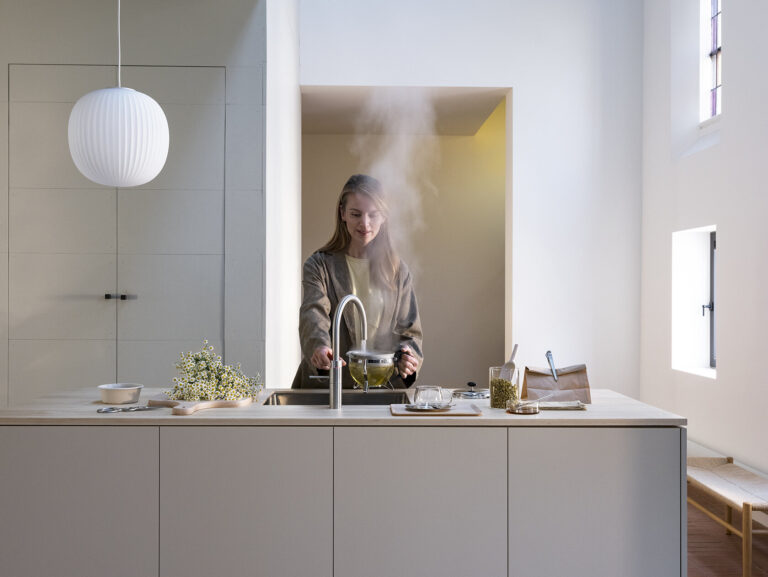
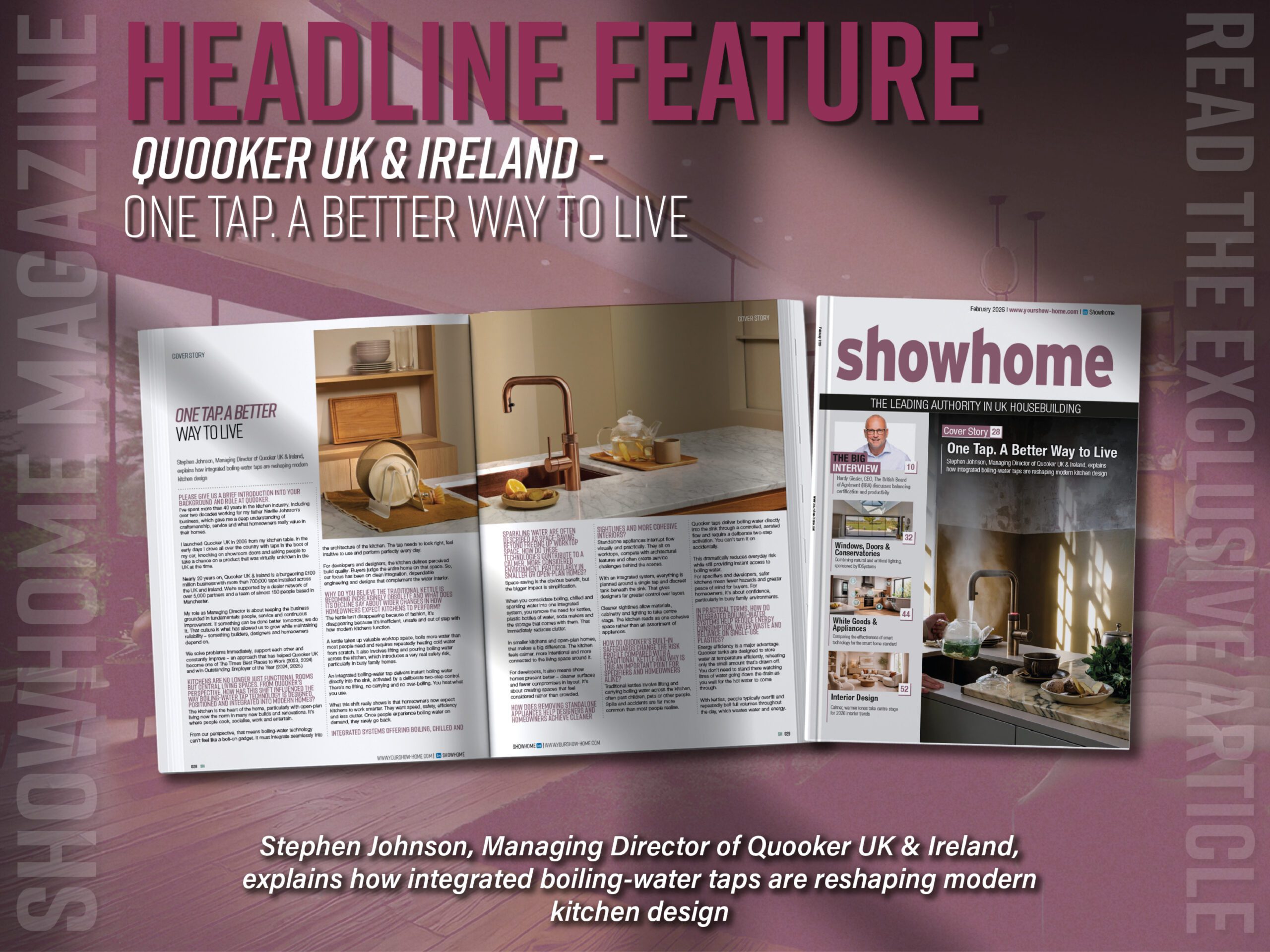

Stephen Johnson, Managing Director of Quooker UK & Ireland, explains how integrated boiling-water taps are reshaping modern kitchen design in the February issue of Showhome.
Please give us a brief introduction into your background and role at Quooker.
I’ve spent more than 40 years in the kitchen industry, including over two decades working for my father Neville Johnson’s business, which gave me a deep understanding of craftsmanship, service and what homeowners really value in their homes.
I launched Quooker UK in 2006 from my kitchen table. In the early days I drove all over the country with taps in the boot of my car, knocking on showroom doors and asking people to take a chance on a product that was virtually unknown in the UK at the time.
Nearly 20 years on, Quooker UK & Ireland is a burgeoning £100 million business with more than 700,000 taps installed across the UK and Ireland. We’re supported by a dealer network of over 5,000 partners and a team of almost 150 people based in Manchester.
My role as Managing Director is about keeping the business grounded in fundamentals: people, service and continuous improvement. If something can be done better tomorrow, we do it. That culture is what has allowed us to grow while maintaining reliability – something builders, designers and homeowners depend on.
We solve problems immediately, support each other and constantly improve – an approach that has helped Quooker UK become one of The Times Best Places to Work (2023, 2024) and win Outstanding Employer of the Year (2024, 2025.)
Kitchens are no longer just functional rooms but central living spaces. From Quooker’s perspective, how has this shift influenced the way boiling-water tap technology is designed, positioned and integrated into modern homes?
The kitchen is the heart of the home, particularly with open-plan living now the norm in many new builds and renovations. It’s where people cook, socialise, work and entertain.
From our perspective, that means boiling-water technology can’t feel like a bolt-on gadget. It must integrate seamlessly into the architecture of the kitchen. The tap needs to look right, feel intuitive to use and perform perfectly every day.
For developers and designers, the kitchen defines perceived build quality. Buyers judge the entire home on that space. So, our focus has been on clean integration, dependable engineering and designs that complement the wider interior.
Why do you believe the traditional kettle is becoming increasingly obsolete and what does its decline say about wider changes in how homeowners expect kitchens to perform?
The kettle isn’t disappearing because of fashion, it’s disappearing because it’s inefficient, unsafe and out of step with how modern kitchens function.
A kettle takes up valuable worktop space, boils more water than most people need and requires repeatedly heating cold water from scratch. It also involves lifting and pouring boiling water across the kitchen, which introduces a very real safety risk, particularly in busy family homes.
An integrated boiling-water tap delivers instant boiling water directly into the sink, activated by a deliberate two-step control. There’s no lifting, no carrying and no over-boiling. You heat what you use.
What this shift really shows is that homeowners now expect kitchens to work smarter. They want speed, safety, efficiency and less clutter. Once people experience boiling water on demand, they rarely go back.
Integrated systems offering boiling, chilled and sparkling water are often described as space-saving. Beyond freeing up worktop space, how do these technologies contribute to a calmer, more considered environment, particularly in smaller or open-plan homes?
Space-saving is the obvious benefit, but the bigger impact is simplification.
When you consolidate boiling, chilled and sparkling water into one integrated system, you remove the need for kettles, plastic bottles of water, soda makers and the storage that comes with them. That immediately reduces clutter.
In smaller kitchens and open-plan homes, that makes a big difference. The kitchen feels calmer, more intentional and more connected to the living space around it.
For developers, it also means show homes present better – cleaner surfaces and fewer compromises in layout. It’s about creating spaces that feel considered rather than crowded.
How does removing standalone appliances help designers and homeowners achieve cleaner sightlines and more cohesive interiors?
Standalone appliances interrupt flow visually and practically. They sit on worktops, compete with architectural features and often create service challenges behind the scenes.
With an integrated system, everything is planned around a single tap and discreet tank beneath the sink. That gives designers far greater control over layout.
Cleaner sightlines allow materials, cabinetry and lighting to take centre stage. The kitchen reads as one cohesive space rather than an assortment of appliances.
How do Quooker’s built-in safeguards change the risk profile compared with a traditional kettle and why is this an important point for specifiers and homeowners alike?
Traditional kettles involve lifting and carrying boiling water across the kitchen, often past children, pets or other people. Spills and accidents are far more common than most people realise.
Quooker taps deliver boiling water directly into the sink through a controlled, aerated flow and require a deliberate two-step activation. You can’t turn it on accidentally.
This dramatically reduces everyday risk while still providing instant access to boiling water.
For specifiers and developers, safer kitchens mean fewer hazards and greater peace of mind for buyers. For homeowners, it’s about confidence, particularly in busy family environments…