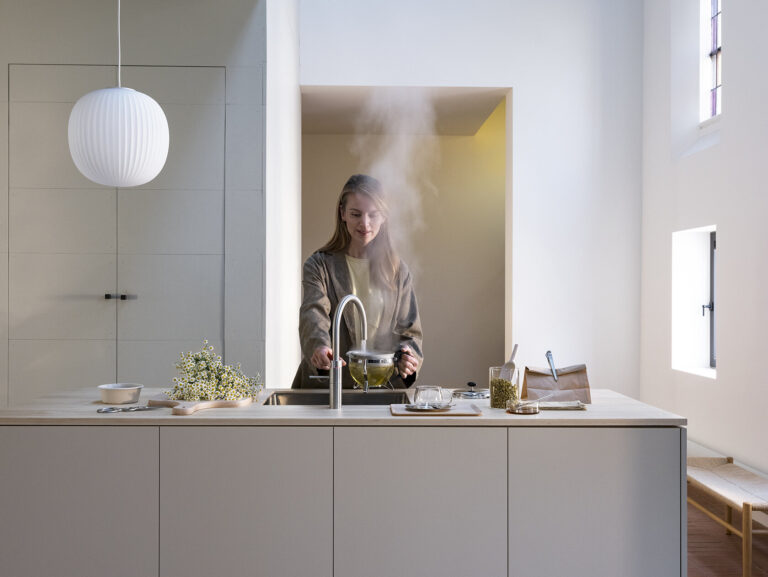


Stephen Johnson, Managing Director of Quooker UK & Ireland, discusses how multifunctional taps are evolving to meet growing demands for convenience, sustainability and integrated kitchen design.
Please introduce yourself and your role at Quooker
I am Stephen Johnson, Managing Director of Quooker UK & Ireland which I launched in the UK in 2006.
I have overseen the growth of the business from a start-up operation to the market leader in multifunctional taps. Today, Quooker has more than 775,000 systems installed across the UK and over 2 million installations throughout Europe.
My role involves leading the UK and Ireland business, working closely with our development, specification, retail and installation partners, and helping to shape the future direction of the multifunctional tap category. Having been involved in the sector from its earliest days, I have had the privilege of seeing boiling water taps evolve from a niche innovation into a mainstream kitchen appliance.
Quooker pioneered the boiling water tap category, but today the conversation is moving towards chilled and sparkling water. What is driving this shift in consumer demand?
I would challenge the assumption that consumer demand has shifted away from boiling water. In our experience, instant boiling water remains the primary reason consumers invest in a multifunctional tap and continues to be the feature that delivers the greatest day-to-day convenience in the kitchen.
What has changed is that consumers increasingly expect more from a single appliance. Once homeowners experience the convenience of having filtered chilled and sparkling water available from the same tap, many view it as a natural extension of the system rather than a separate product category.
As the company that pioneered the boiling water tap category, and with more than 775,000 systems installed in the UK and over 2 million across Europe, we have a unique perspective on how consumer preferences are evolving. The demand for chilled and sparkling water is certainly growing, but it is growing alongside demand for boiling water, not replacing it.
Interest also varies significantly across the country. Local water quality plays an important role in consumer decision-making. Around half of UK water supplies would not be suitable for ambient filtered water or chilled and sparkling filtered water without additional treatment, making correct specification particularly important.
Ultimately, we see the future not as a choice between boiling water and chilled and sparkling water, but as a move towards truly multifunctional systems that provide the right water for every occasion from a single tap.
How is the demand for chilled and sparkling water influencing modern kitchen design and appliance specification?
The biggest influence is the continued move towards simplicity, integration, and uncluttered living spaces.
Modern kitchens are expected to do more than ever before. They have become social spaces, entertainment areas and family hubs. As a result, homeowners increasingly want appliances that perform multiple functions without occupying additional worktop space.
For developers and designers, this means greater emphasis on clean lines, minimalism and hidden technology. Increasingly, premium kitchens are being designed around integrated solutions that enhance both aesthetics and functionality.
What role does filtered water quality play in consumer decision making, and how important is this becoming within the wider multifunctional tap category?
Water quality has become a far more significant consideration than it was even five years ago.
Consumers are increasingly aware of factors such as taste, odour, limescale, and overall drinking water quality. They are also more conscious of the environmental impact and cost associated with purchasing bottled water.
However, there is no universal answer because water quality varies considerably throughout the UK. This is why specification should be based on local conditions rather than assumptions. As the category continues to mature, we expect filtered water quality to become an increasingly important part of the purchasing decision.
How can developers ensure they are specifying a system that will deliver long-term reliability and minimise future maintenance requirements for homeowners?
Developers should look beyond the tap itself and evaluate the entire ecosystem behind the product.
They should consider the manufacturer’s track record, installed base, technical support infrastructure, spare parts availability and aftercare capability. A multifunctional tap is a system that homeowners will rely upon every day.
One of the most common mistakes we see is the assumption that all boiling water taps are fundamentally the same. They are not. The technology, performance, service infrastructure and user experience can vary considerably between manufacturers.
If a homeowner expects true 100°C boiling water and the product cannot deliver it, there is a genuine risk of disappointment from day one. Whether making tea, preparing food or carrying out everyday kitchen tasks, consumers notice the difference. For developers, specification is ultimately about delivering the experience that was promised at the point of sale.
Reliability comes from a combination of quality engineering, correct installation, strong after-sales support and selecting a system that consistently meets homeowner expectations over the long term.
With sustainability becoming a key consideration for both homeowners and developers, how can multifunctional taps contribute to more resource-efficient kitchens?
Multifunctional taps can contribute to resource efficiency in several ways.
They help reduce water waste by allowing users to dispense exactly the amount of water required rather than overfilling kettles. Integrated filtration can reduce reliance on bottled water, helping to minimise plastic consumption and transport-related emissions.
Combining multiple functions into a single appliance also reduces the need for separate devices, contributing to a more streamlined and efficient kitchen environment.
How straightforward is the installation process for housebuilders and contractors compared to traditional kitchen tap solutions?
For trained professionals, installation is straightforward and well established.
The process differs from fitting a standard kitchen tap because there is an under-sink system that must be installed and commissioned correctly. However, modern systems are specifically designed to make installation as efficient as possible.
For developers delivering multiple plots, consistency is often more important than speed alone. Manufacturer training, technical support and clear installation guidance help ensure a positive experience for both builders and homeowners.
What misconceptions still exist around multifunctional taps, and how has consumer understanding changed in recent years?
The category has matured significantly, but a few misconceptions still remain.
The first is safety. Some consumers initially assume that a boiling water tap must be less safe than a kettle, when modern systems incorporate multiple safety mechanisms.
The second is energy consumption. Many people assume a boiling water system must be expensive to run. In practice, modern insulated systems are highly efficient.
Consumer understanding has evolved dramatically over the last decade. What was once viewed as an innovative luxury product is increasingly regarded as an expected feature within premium kitchens.
Looking ahead, do you expect chilled and sparkling water functionality to become a standard expectation in premium kitchens?
I believe homeowners will increasingly expect their kitchen tap to do far more than simply provide hot and cold water. The direction of travel is clearly towards multifunctionality.
Whether that is boiling water, chilled water, sparkling water or advanced filtration, consumers increasingly value convenience, integration and the efficient use of space.
We have already seen boiling water move from a premium innovation to an expected feature in many kitchens. Chilled and sparkling water is following a similar trajectory, particularly within premium developments.
The real opportunity for developers is not simply to follow trends, but to anticipate how consumers will live in their homes over the next decade. The most successful specifications are those that continue to add value long after the property has been handed over.
What factors should developers prioritise when specifying systems that will continue to deliver value, performance and homeowner satisfaction long after project completion?
The multifunctional tap category has matured significantly over the last twenty years. The conversation today is no longer simply about convenience; it is about performance, sustainability, design integration and long-term homeowner satisfaction.
For developers, the challenge is not selecting the lowest-cost solution, but selecting the solution that will continue to delight homeowners years after completion.
With more than 775,000 systems installed in the UK and over 2 million throughout Europe, we have seen first-hand what drives long-term success. Reliability, service support, true 100°C boiling water, proven engineering and exceptional customer experience remain the foundations of a successful specification.
Ultimately, homeowners remember how a product performs long after they have forgotten what it cost. That is why getting the specification right from the outset is so important.