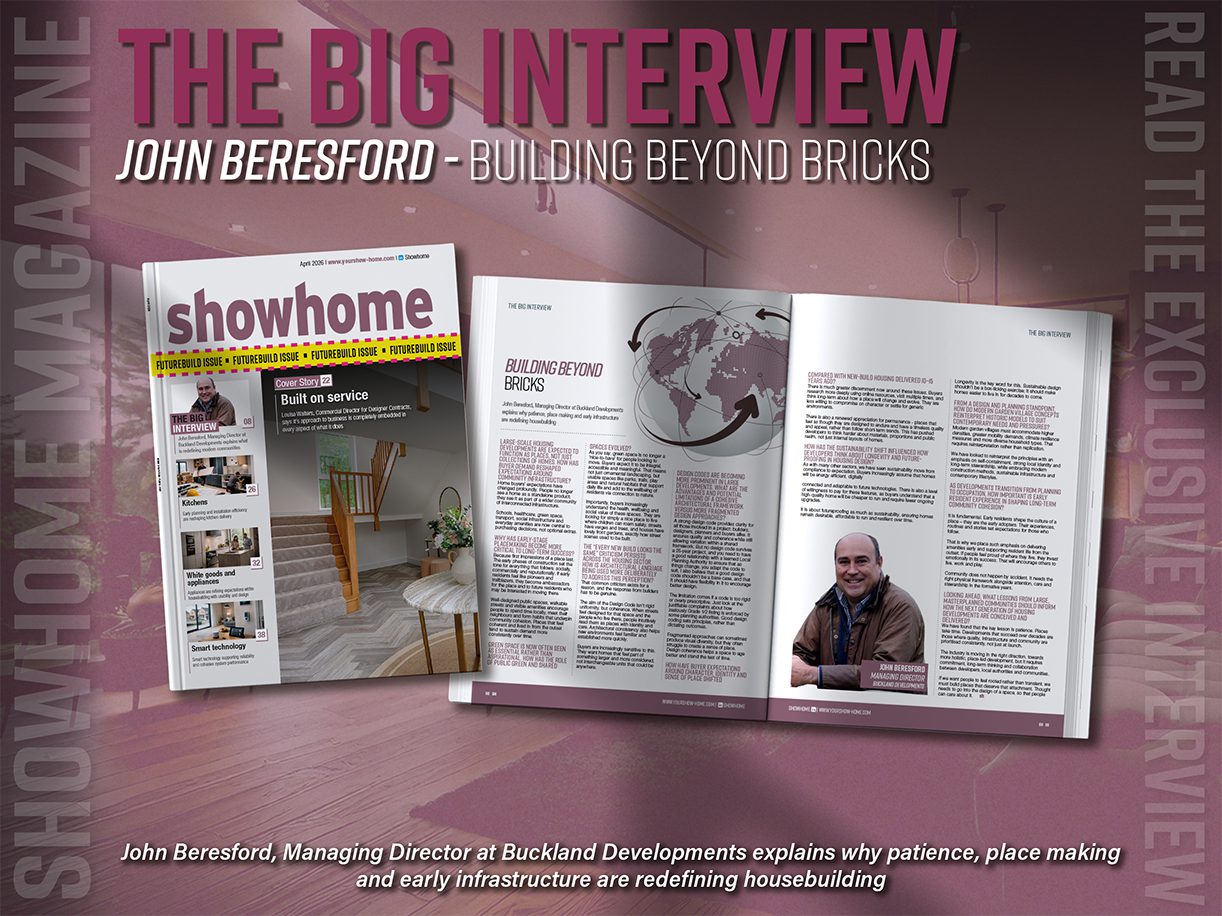

John Beresford, Managing Director at Buckland Developments explains why patience, placemaking, and early infrastructure delivery are redefining how modern communities are designed, delivered, and experienced.
Large-scale housing developments are expected to function as places, not just collections of homes. How has buyer demand reshaped expectations around community infrastructure?
Home buyers’ expectations have changed profoundly. People no longer see a home as a standalone product; they see it as part of a wider community of interconnected infrastructure.
Schools, healthcare, green space, transport, social infrastructure and everyday amenities are now central to purchasing decisions, not optional extras.
Why has early-stage placemaking become more critical to long-term success?
Because first impressions of a place last. The early phases of construction set the tone for everything that follows: socially, commercially and reputationally. If early residents feel like pioneers and trailblazers, they become ambassadors for the place and to future residents who may be interested in moving there.
Well-designed public spaces, walkable streets and visible amenities encourage people to spend time locally, meet their neighbours and form habits that underpin community cohesion. Places that feel coherent and lived in from the outset tend to sustain demand more consistently over time.
Green space is now often seen as essential rather than aspirational. How has the role of public green and shared spaces evolved?
As you say, green space is no longer a ‘nice-to-have’ for people looking to move. Buyers expect it to be integral, accessible and meaningful. That means not just ornamental landscaping, but usable spaces like parks, trails, play areas and natural habitats that support daily life and add to the wellbeing of residents via connection to nature.
Importantly, buyers increasingly understand the health, wellbeing and social value of these spaces. They are looking for simply a nice place to live where children can roam safely, streets have verges and trees, and houses have lovely front gardens, exactly how street scenes used to be built.
The “every new build looks the same” criticism persists across the housing sector. How is architectural language being used more deliberately to address this perception?
That common criticism exists for a reason, and the response from builders has to be genuine.
The aim of the Design Code isn’t rigid uniformity, but coherence. When streets feel designed for that space and the people who live there, people intuitively read them as places with identity and care. Architectural consistency also helps new environments feel familiar and established more quickly.
Buyers are increasingly sensitive to this. They want homes that feel part of something larger and more considered, not interchangeable units that could be anywhere.
Design codes are becoming more prominent in large developments. What are the advantages and potential limitations of a cohesive architectural framework versus more fragmented design approaches?
A strong design code provides clarity for all those involved in a project: builders, designers, planners and buyers alike. It ensures quality and coherence while still allowing variation within a shared framework. But no design code survives a 25-year project, and you need to have a good relationship with a learned Local Planning Authority to ensure that as things change, you adapt the code to suit. I also believe that a good design code shouldn’t be a base case, and that it should have flexibility in it to encourage better design.
The limitation comes if a code is too rigid or overly prescriptive. Just look at the justifiable complaints about how zealously Grade 1/2 listing is enforced by some planning authorities. Good design coding sets principles, rather than dictating outcomes.
Fragmented approaches can sometimes produce visual diversity, but they often struggle to create a sense of place. Design coherence helps a space to age better and stand the test of time.
How have buyer expectations around character, identity and sense of place shifted compared with new-build housing delivered 10–15 years ago?
There is much greater discernment now around these issues. Buyers research more deeply using online resources, visit multiple times, and think long-term about how a place will change and evolve. They are less willing to compromise on character or settle for generic environments.
There is also a renewed appreciation for permanence – places that feel as though they are designed to endure and have a timeless quality and appeal, rather than follow short-term trends. This has pushed developers to think harder about materials, proportions and public realm, not just internal layouts of homes.
How has the sustainability shift influenced how developers think about longevity and future-proofing in housing design?
As with many other sectors, we have seen sustainability move from compliance to expectation. Buyers increasingly assume that homes will be energy efficient, digitally connected and adaptable to future technologies. There is also a level of willingness to pay for these features, as buyers understand that a high-quality home will be cheaper to run and require fewer ongoing upgrades.
It is about futureproofing as much as sustainability, ensuring homes remain desirable, affordable to run and resilient over time.
Longevity is the key word for this. Sustainable design shouldn’t be a box-ticking exercise; it should make homes easier to live in for decades to come.
From a design and planning standpoint, how do modern garden village concepts reinterpret historic models to suit contemporary needs and pressures?
Modern garden villages must accommodate higher densities, greater mobility demands, climate resilience measures and more diverse household types. That requires reinterpretation rather than replication.
We have looked to reinterpret the principles with an emphasis on self-containment, strong local identity and long-term stewardship, while embracing modern construction methods, sustainable infrastructure and contemporary lifestyles.
As developments transition from planning to occupation, how important is early resident experience in shaping long-term community cohesion?
It is fundamental. Early residents shape the culture of a place – they are the early adopters. Their experiences, routines and stories set expectations for those who follow.
That is why we place such emphasis on delivering amenities early and supporting resident life from the outset. If people feel proud of where they live, they invest emotionally in its success. That will encourage others to live, work and play.
Community does not happen by accident. It needs the right physical framework alongside attention, care and stewardship in the formative years.
Looking ahead, what lessons from large, masterplanned communities should inform how the next generation of housing developments are conceived and delivered?
We have found that the key lesson is patience. Places take time. Developments that succeed over decades are those where quality, infrastructure and community are prioritised consistently, not just at launch.
The industry is moving in the right direction, towards more holistic, place-led development, but it requires commitment, long-term thinking and collaboration between developers, local authorities and communities.
If we want people to feel rooted rather than transient, we must build places that deserve that attachment. Thought needs to go into the design of a space, so that people can care about it.