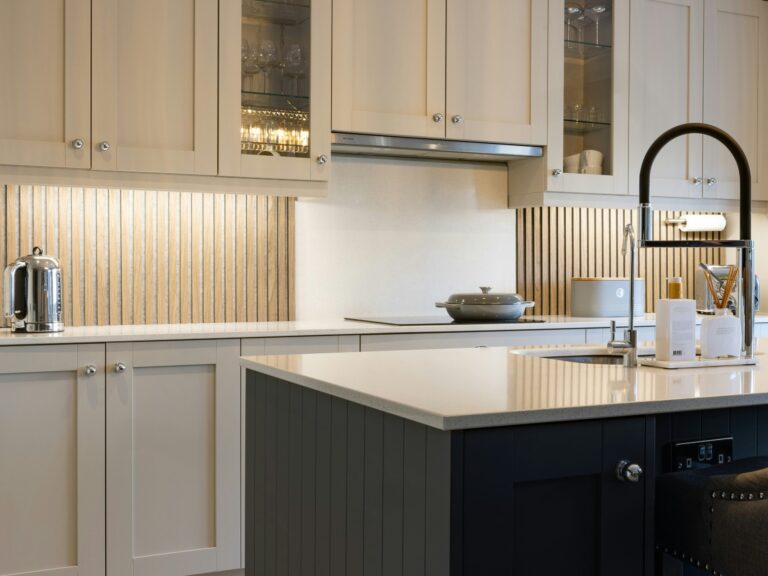


Rebecca Spayne looks at how luxury kitchens have entered a new era, analysing how materials, accents and cabinetry are bettering total cost of ownership with a luxury feel
The Luxury Kitchen
The luxury kitchen has always been the centrepiece of high value residential design. For decades, luxury has been defined by the visual experience of the space. Marble worktops, statement islands, sculptural taps, and banked appliances created the first impression that buyers expected from premium new builds. Today, that equation has changed. Developers, architects and interior designers are now working with a more exacting and better-informed buyer. These homeowners are not simply looking for beautiful surfaces. They want evidence that those surfaces will endure, that appliances will perform at the highest standards for years, and that the materials chosen today will not quietly deteriorate or incur unexpected costs in the future.
Luxury is now tied directly to lifecycle. A kitchen can only be called premium if it performs, if it stands up to daily wear, and if the investment made at specification stage continues to hold value throughout the occupancy of the home. This shift has placed total cost of ownership at the forefront of decision making. In practice, this means that every element from drawer runners to composite sinks to intelligent cooking appliances is scrutinised not only for aesthetic merit but for longevity, maintenance needs and operational efficiency.
Material brands such as Caesarstone have long been associated with the luxury end of the new build market because their quartz surfaces offer consistency, resilience and a reliable maintenance profile. That reliability is increasingly being viewed as a form of financial assurance. Similarly, high quality cabinetry systems supported by engineering specialists such as Blum are chosen not simply for the feel of a soft close mechanism, but for the confidence that those same mechanisms will still perform as intended in a decade. The language of luxury has matured. It now includes lifecycle curves, predicted replacement intervals and performance modelling as comfortably as it includes colour palettes and interior mood boards.
Why Total Cost of Ownership is Becoming a Design Essential
The rise of the luxury rental sector has accelerated this change. In high value build to rent developments, every component in the kitchen must be assessed through the lens of durability and operational cost. A replacement appliance in year three or a scratched worktop in year one is no longer viewed as an inconvenience. It is an avoidable operational cost. Even in the owner occupier market, the lesson is the same. Buyers who invest at the top end of the market expect transparent reasoning behind material and appliance selection. They want assurance that what looks impressive on completion day will still be performing faultlessly five years later.
This is where total cost of ownership has entered the mainstream conversation. For developers, TCO is not a technical concept. It is a practical tool that shapes specification strategy. It forces the design team to consider how each material responds to heat, moisture, cleaning cycles and prolonged use. It examines the energy demand of appliances and whether next generation models will reduce the long term operational costs for the end user. It also forces a sober appraisal of maintenance requirements. A luxury kitchen that requires constant attention quickly loses its value perception…
Read the full article
To read the full article please see our December issue here: https://yourshow-home.com/tag/keller-kitchens/