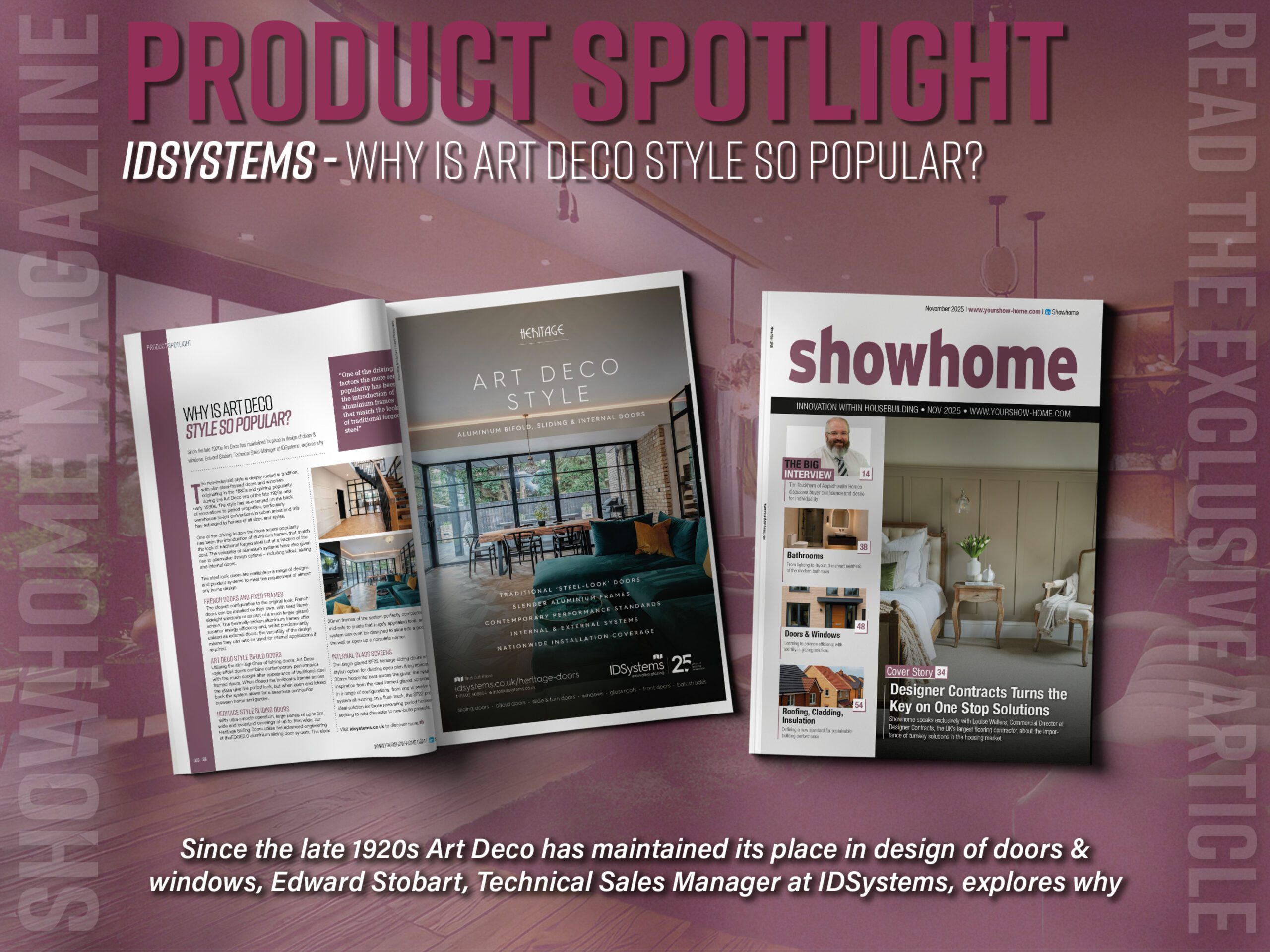

Since the late 1920s Art Deco has maintained its place in design of doors & windows, Edward Stobart, Technical Sales Manager at IDSystems, explores why.
The neo-industrial style is deeply rooted in tradition, with slim steel-framed doors and windows originating in the 1880s and gaining popularity during the Art Deco era of the late 1920s and early 1930s. The style has re-emerged on the back of renovations to period properties, particularly warehouse-to-loft conversions in urban areas and this has extended to homes of all sizes and styles.
One of the driving factors the more recent popularity has been the introduction of aluminium frames that match the look of traditional forged steel but at a fraction of the cost. The versatility of aluminium systems have also given rise to alternative design options – including bifold, sliding and internal doors.
The steel look doors are available in a range of designs and product systems to meet the requirement of almost any home design.
French doors and fixed frames
The closest configuration to the original look, French doors can be installed on their own, with fixed frame sidelight windows or as part of a much larger glazed screen. The thermally-broken aluminium frames offer superior energy efficiency and, whilst predominantly utilised as external doors, the versatility of the design means they can also be used for internal applications if required.
Art Deco style bifold doors
Utilising the slim sightlines of folding doors, Art Deco style bifold doors combine contemporary performance with the much sought-after appearance of traditional steel framed doors. When closed the horizontal frames across the glass give the period look, but when open and folded back the system allows for a seamless connection between home and garden.
Heritage style sliding doors
With ultra-smooth operation, large panels of up to 2m wide and oversized openings of up to 16m wide, our Heritage Sliding Doors utilise the advanced engineering of theEDGE2.0 aluminium sliding door system. The sleek 20mm frames of the system perfectly complement the mid-rails to create that hugely appealing look, and the system can even be designed to slide into a pocket in the wall or open up a complete corner.