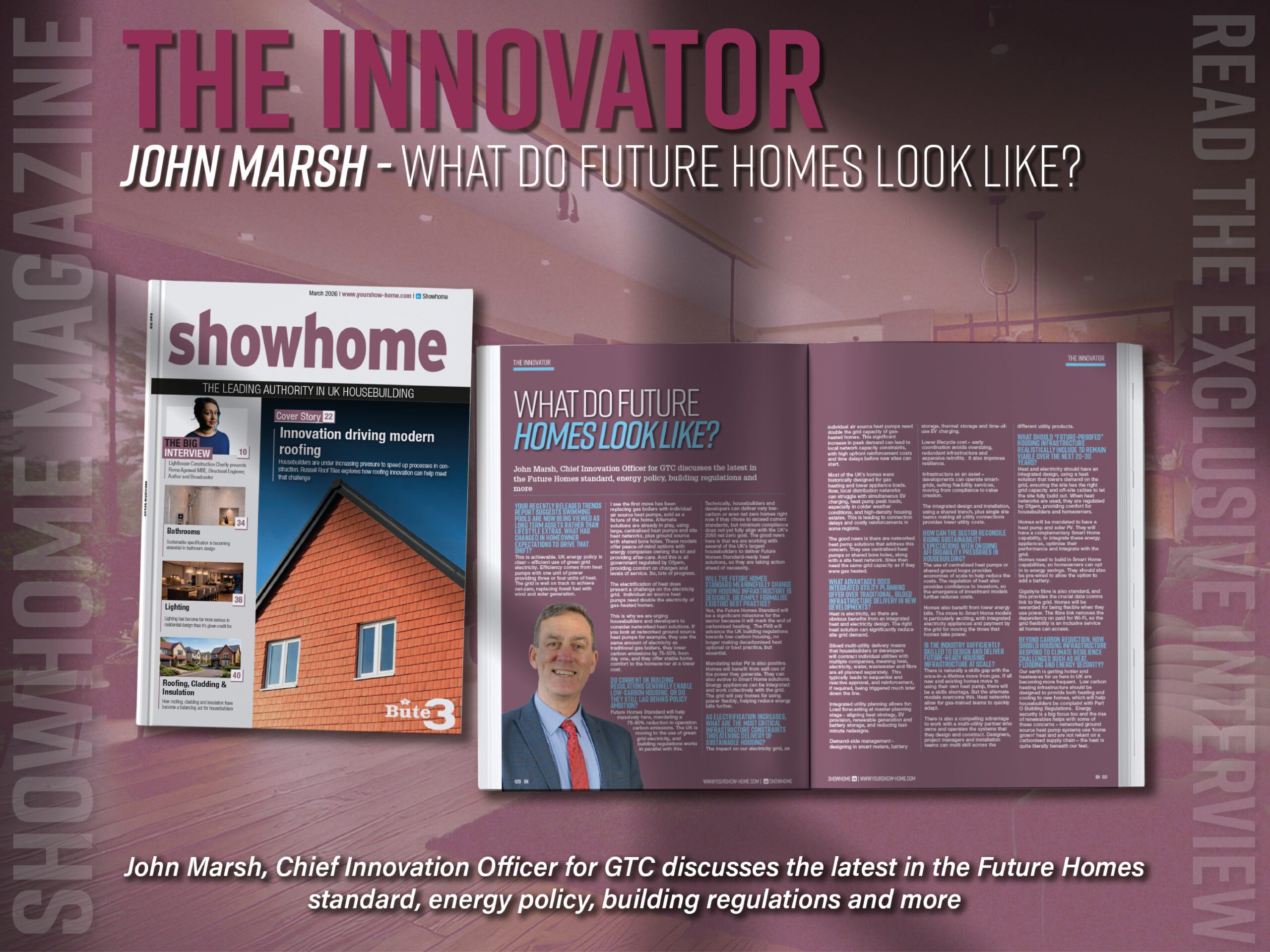

John Marsh, Chief Innovation Officer for GTC discusses the latest in the Future Homes standard, energy policy, building regulations and more.
How realistic is the housing sector’s ability to meet net-zero targets at scale, given current build rates and infrastructure constraints?
This is achievable. UK energy policy is clear – efficient use of green grid electricity. Efficiency comes from heat pumps with one unit of power providing three or four units of heat. The grid is well on track to achieve net-zero, replacing fossil fuel with wind and solar generation.
I see the first move has been replacing gas boilers with individual air source heat pumps, sold as a fixture of the home. Alternate solutions are already in play, using large, centralised heat pumps and site heat networks, plus ground source with shared bore holes. These models offer peace-of-mind options with energy companies owning the kit and providing after-care. And this is all government regulated by Ofgem, providing comfort on charges and levels of service. So, lots of progress.
The electrification of heat does present a challenge on the electricity grid. Individual air source heat pumps need double the electricity of gas-heated homes.
This is why we are urging housebuilders and developers to consider networked heat solutions. If you look at networked ground source heat pumps for example, they use the same amount of electricity as traditional gas boilers, they lower carbon emissions by 75-50% from day one, and they offer stable home comfort to the homeowner at a lower cost.
Do current UK building regulations genuinely enable low-carbon housing, or do they still lag behind policy ambition?
Future Homes Standard will help massively here, mandating a 75-80% reduction in operation carbon emissions. The UK is moving to the use of green grid electricity, and building regulations works in parallel with this.
Technically, housebuilders and developers can deliver very low-carbon or even net zero homes right now if they chose to exceed current standards, but minimum compliance does not yet fully align with the UK’s 2050 net zero goal. The good news here is that we are working with several of the UK’s largest housebuilders to deliver Future Homes Standard-ready heat solutions, so they are taking action ahead of necessity.
Will the Future Homes Standard meaningfully change how housing infrastructure is designed, or simply formalise existing best practice?
Yes, the Future Homes Standard will be a significant milestone for the sector because it will mark the end of carbonised heating. The FHS will advance the UK building regulations towards low-carbon housing, no longer making decarbonised heat optional or best practice, but essential.
Mandating solar PV is also positive. Homes will benefit from self-use of the power they generate. They can also evolve to Smart Home solutions. Energy appliances can be integrated and work collectively with the grid. The grid will pay homes for using power flexibly, helping reduce energy bills further.
As electrification increases, what are the most critical infrastructure constraints threatening delivery of sustainable housing?
The impact on our electricity grid, as individual air source heat pumps need double the grid capacity of gas-heated homes. This significant increase in peak demand can lead to local network capacity constraints, with high upfront reinforcement costs and time delays before new sites can start.
Most of the UK’s homes were historically designed for gas heating and lower appliance loads. Now, local distribution networks can struggle with simultaneous EV charging, heat pump peak loads, especially in colder weather conditions, and high-density housing estates. This is leading to connection delays and costly reinforcements in some regions.
The good news is there are networked heat pump solutions that address this concern. They use centralised heat pumps or shared bore holes, along with a site heat network. Sites then need the same grid capacity as if they were gas heated.
What advantages does integrated utility planning offer over traditional, siloed infrastructure delivery in new developments?
Heat is electricity, so there are obvious benefits from an integrated heat and electricity design. The right heat solution can significantly reduce site grid demand.
Siloed multi-utility delivery means that housebuilders or developers will contract individual utilities with multiple companies, meaning heat, electricity, water, wastewater and fibre are all planned separately. This typically leads to sequential and reactive approval, and reinforcement, if required, being triggered much later down the line.
Integrated utility planning allows for: Load forecasting at master planning stage – aligning heat strategy, EV provision, renewable generation and battery storage, and reducing last-minute redesigns.
Demand-side management – designing in smart meters, battery storage, thermal storage and time-of-use EV charging.
Lower lifecycle cost – early coordination avoids oversizing, redundant infrastructure and expensive retrofits. It also improves resilience.
Infrastructure as an asset – developments can operate smart-grids, selling flexibility services, moving from compliance to value creation.
The integrated design and installation, using a shared trench, plus single site teams making all utility connections provides lower utility costs.
How can the sector reconcile rising sustainability expectations with ongoing affordability pressures in housebuilding?
The use of centralised heat pumps or shared ground loops provides economies of scale to help reduce the costs. The regulation of heat also provides confidence to investors, so the emergence of investment models further reduces costs.
Homes also benefit from lower energy bills. The move to Smart Home models is particularly exciting, with integrated electricity appliances and payment by the grid for moving the times that homes take power.
Is the industry sufficiently skilled to design and deliver future-ready housing infrastructure at scale?
There is naturally a skills gap with the once-in-a-lifetime move from gas. If all new and existing homes move to using their own heat pump, there will be a skills shortage. But the alternate models overcome this. Heat networks allow for gas-trained teams to quickly adapt.
There is also a compelling advantage to work with a multi-utility partner who owns and operates the systems that they design and construct. Designers, project managers and installation teams can multi skill across the different utility products.
What should “future-proofed” housing infrastructure realistically include to remain viable over the next 20–30 years?
Heat and electricity should have an integrated design, using a heat solution that lowers demand on the grid, ensuring the site has the right grid capacity and off-site cables to let the site fully build out. When heat networks are used, they are regulated by Ofgem, providing comfort for housebuilders and homeowners.
Homes will be mandated to have a heat pump and solar PV. They will have a complementary Smart Home capability, to integrate these energy appliances, optimise their performance and integrate with the grid.
Homes need to build in Smart Home capabilities, so homeowners can opt in to energy savings. They should also be pre-wired to allow the option to add a battery.
Gigabyte fibre is also standard, and this provides the crucial data comms link to the grid. Homes will be rewarded for being flexible when they use power. The fibre link removes the dependency on paid for Wi-Fi, so the grid flexibility is an inclusive service all homes can access.
Beyond carbon reduction, how should housing infrastructure respond to climate resilience challenges such as heat, flooding and energy security?
Our earth is getting hotter and heatwaves for us here in UK are becoming more frequent. Low carbon heating infrastructure should be designed to provide both heating and cooling to new homes, which will help housebuilders be complaint with Part O Building Regulations. Energy security is a big focus too and the rise of renewables helps with some of these concerns – networked ground source heat pump systems use ‘home grown’ heat and are not reliant on a carbonised supply chain – the heat is quite literally beneath our feet.