
Housebuilder Lovell Homes has selected Vent-Axia’s Lo-Carbon Sentinel Kinetic Cooker Hood MVHR (Mechanical Ventilation with Heat Recovery) and the Lo-Carbon NBR dMEV C (decentralised Mechanical Extract Ventilation) as part of its Tomorrow Home project at Cornish Park in Spennymoor, County Durham. The Tomorrow Home project consists of demonstration homes built to test alternative electric heating systems directly against each other, as well as assessing the effective performance of a range of sustainable technologies, including ventilation.
Tomorrow Home features two identical, three-bedroom, semi-detached homes that have been built to an interpretation of the anticipated Future Homes Standard, with improved building fabric. In one of the three-bedroom homes a Vent-Axia Lo-Carbon Sentinel Kinetic Cooker Hood MVHR has been installed, the other has been fitted with Lo-Carbon NBR dMEV C. Lovell Homes are working with Teesside University and the Net Zero Industry Innovation Centre to monitor electricity usage, internal temperature, humidity and air quality within the homes.
“Vent-Axia’s Lo-Carbon NBR dMEV C is currently fitted as standard in Lovell open market sales house types, with dMEV recommended as a solution in the Future Homes Standard consultation document. Meanwhile, we chose the Lo-Carbon Sentinel Kinetic Cooker Hood for this trial because we see MVHR as being the most probable ventilation strategy for Net-Zero homes as airtightness is increased. We look forward to monitoring the performance of both these technologies in the two homes,” said Iain Gillies, Divisional Design & Innovation Manager at Lovell Homes. “We want to ensure that the thermal comfort and ventilation meets the needs of our customers. We will also evaluate the experiences of individuals who use the homes.”
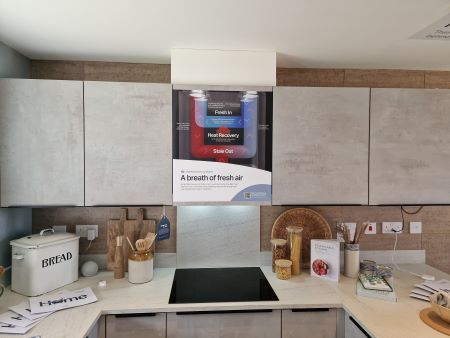
“We are delighted that Lovell Homes has chosen our Lo-Carbon NBR dMEV C unit and Sentinel Kinetic Cooker Hood MVHR to test in its demonstration homes. The Lo-Carbon NBR dMEV C was designed to achieve the latest Building Regulation ventilation rates while improving indoor air quality (IAQ), using the lowest number of installed fans, and the most efficient and quietest fans on the market”, explains Steve Pearce, Product Manager at Vent-Axia. “Meanwhile, the Sentinel Kinetic Cooker Hood offers whole house heat recovery ventilation combined with extraction during cooking all in one unit, saving valuable space and improving IAQ.”
Data gathered from the demonstration homes will enable Lovell Homes to gauge the various technologies in-use and their performance, including ventilation. The project will last 12 months and will give the housebuilder an opportunity to test MVHR and dMEV over an extended period of time and allow the company to gain the knowledge to develop its designs and specifications to meet the forthcoming challenges of the Future Homes Standard and Net Zero.
The Lo-Carbon NBR dMEV C, is a highly efficient dMEV unit designed for kitchen, utility, bathroom and cloakroom applications. It achieves Building Regulations with the quietest sound levels, the lowest number of installed fans required and the most efficient fans on the market. Developed for housebuilders, it is tested to the new SAP 10 performance requirement and listed in the PCDB with its exceedingly low Specific Fan Power (SFP) values as impressively low as 0.08 w/l/s and provides near silent operation independently tested as low as 7.4 dB(A).
Read more news and exclusive features in our latest issue here.
Never miss a story… Follow us on:
Showhome
@Your_Show_Home
@Showhomemag
Media Contact
Joseph Clarke
Editor, Showhome
Tel: +44 (0) 1622 823 920
Email: editor@yourshow-home.com