
Majid Khan, Business Development Director, Caesarstone UK & Ireland, discusses the changing demands of housebuilders and developers in surface specification
Please give us a brief introduction into your background and role at Caesarstone UK.
My career has centred on connecting manufacturers, developers, and the wider construction community to create shared value. Prior to joining Caesarstone, I worked extensively with brands serving the new-build and refurbishment sectors, gaining insight into what developers need from supply partners: predictability, compliance, ease of installation, and environments that customers feel proud of.
At Caesarstone, I manage relationships with housebuilders, developers, build-to-rent operators, and management companies across the UK and Ireland. My focus is ensuring we deliver not only beautiful surfaces, but the reliability, brand confidence, lifecycle value, and technical assurance major residential and mixed-use schemes require. As developer needs evolve, my role is to ensure Caesarstone remains a trusted partner that anticipates change and supports customers throughout their project journey.
Developers are increasingly prioritising transparent, predictable pricing structures. How is Caesarstone responding to this shift, and where does the Essentials range sit within that strategy?
Predictable pricing has become one of the key requirements for developers, particularly for multi-phase projects. Volatile costs create uncertainty for procurement teams and can destabilise specifications, so we’ve focused on building agreements that offer clarity and long-term consistency.
Our Essentials range was created directly in response to developers seeking recognisable, premium branding with differentiated designs while maintaining cost control on volume schemes. Essentials provides a simple, stable, developer-friendly pricing structure that allows Caesarstone to be included in standard specification without the risk and inconsistency associated with less established suppliers. It has become a model for how high-quality branded surfaces can be made accessible at scale while maintaining value and predictability.
There is clear growth in buyer expectations for branded, high-value surfaces. What factors do you believe are driving this trend, and why is Caesarstone resonating so strongly with today’s consumers?
Buyer expectations have shifted dramatically. Consumers today are more design literate, more brand aware, and more confident about what they want in their homes. Social media plays a major role in normalising premium aesthetics and exposing buyers to a broader range of materials. In this environment, trusted brands matter.
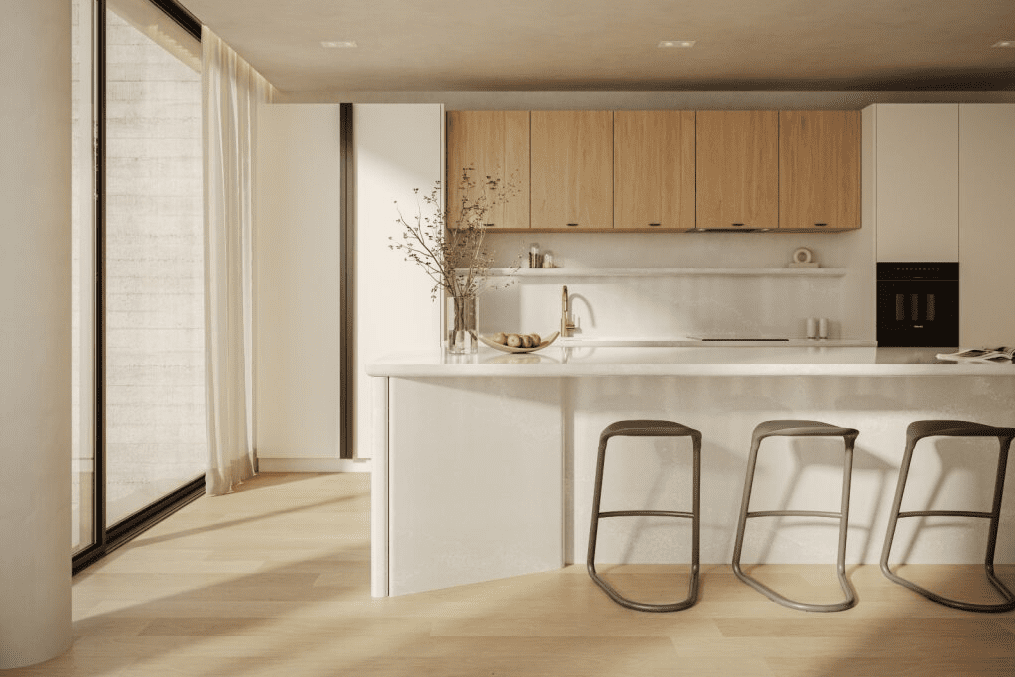
Caesarstone resonates because it combines beauty, durability, and trust. Buyers recognise the brand and see it as a genuine upgrade over unbranded alternatives. A high-quality worktop has become one of the clearest visual indicators of overall home quality. As the kitchen increasingly becomes the emotional centre of the home, a premium branded worktop provides both aesthetic appeal and reassurance of long-term value.
How significant is brand recognition when it comes to perceived property value, and what evidence are you seeing that worktops influence purchase decisions in both new build and renovation schemes?
Brand recognition strongly influences perceived value. I’m told that show homes featuring Caesarstone consistently attract greater engagement, higher perceived worth, and smoother reservation processes. Buyers take it as a sign that the developer prioritised quality rather than minimum compliance.
Renovation schemes reflect the same trend. Estate agents will reference Caesarstone in property listings because it increases desirability. A premium branded worktop elevates both aesthetic and perceived value, helping developers differentiate in a competitive market….